Include’s environmental strategy was adopted in 2020. The strategy focuses mainly on travel and food consumption, the two areas with the greatest potential for reducing the environmental impact of Include’s research activities.
Has stopped flying
We ask one of our own researchers, Per Gunnar Røe, how he himself relates to the strategy.
Are you conscious of which journeys you make, and how you make them?
- Yes, that is something I care about, perhaps because I do research on sustainable urban development and mobility. In my daily journeys to and from work I use the train and the underground. In everyday life otherwise, I try to use our electric car as little as possible. I’m lucky to live somewhere where I can walk to the store and take the train to Oslo or other places, says Røe.
- But we have a cabin in Østerdalen, and we drive there.
The Include researcher says that the biggest change he has made in the last five years is to try to avoid air travel altogether, both for work and in his free time.
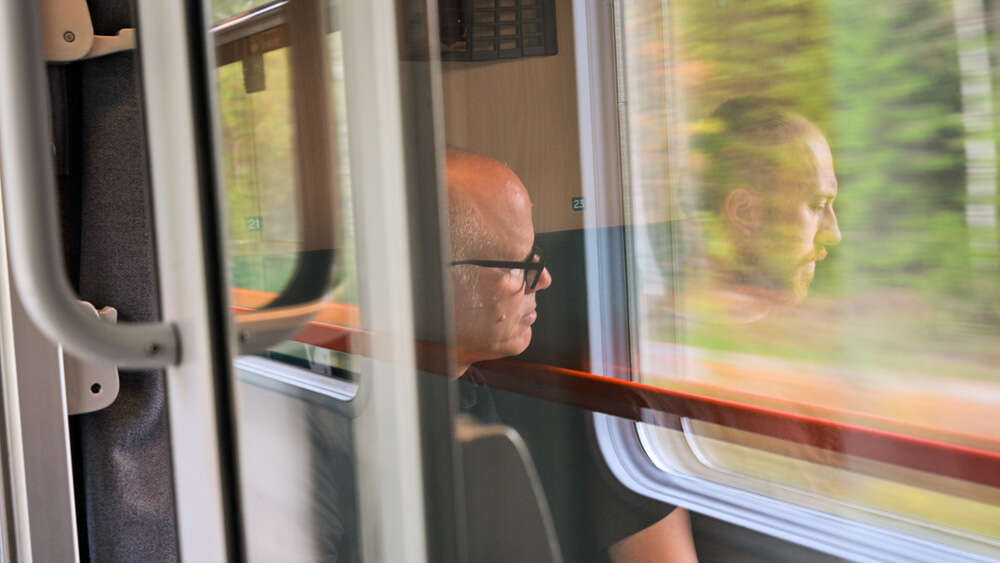
- I travel by train to Stavanger, Bergen and Trondheim, and to conferences and meetings in Europe. I also try to "bundle" conference participation, meetings and other activities into the same trip.
A family cooperation project
The environmental strategy states that we should eat seasonal, vegetarian/vegan and organic food as far as possible – and avoid throwing food away.
What steps are you taking to eat sustainably?
- I’ve become more conscious of what I eat and what I throw away. I mostly eat vegetarian food, some fish and rarely meat. That applies both at work and outside work. But I’ve also become concerned about food waste, which means that it can sometimes be good to eat meat if the alternative is that it will be thrown away.
Choices about food and travel are linked to family practices, Røe explains, adding that it has been absolutely crucial that the other members of the family are also concerned with reducing their footprint.
- So it isn’t difficult to gain support for this, which has been important. It has also become a kind of cooperation project within the family.
Guidelines must be possible to follow
Per Gunnar Røe was concerned with living sustainably even before Include was established.
- But the strategy has definitely influenced my choices. I’ve thought that I, with a flexible everyday life and no small children, can quite easily "test out" the strategy. But I fully understand that, for many, it can be demanding to follow it.
What do you think about institutions such as the University of Oslo having clear guidelines for environmental choices?
- I think it’s important to have guidelines and advice, but in order for them to be followed there must be schemes, services and financial resources in place. This means that, for example, it has to be acceptable not to choose the cheapest way of travelling, and that there are people who can help, especially when it comes to booking travel and food. At the University of Zurich, the faculty covers all fieldwork and conference travel that is done by train.
Different premises and opportunities
The Include researcher says that there are many factors to consider when it comes to being able to choose to live sustainably, and he acknowledges that it is not always so easy to make the right choices.
What are the biggest barriers to us making more environmentally friendly choices?
- I think it has less to do with knowledge, and increasingly depends on individual resources, culture, lifestyle and political-economic structures. People have very different premises and opportunities for making sustainable choices. Sustainable solutions are often expensive, time-consuming and require a degree of flexibility that many people do not have.
Røe himself says that he is privileged and, to a large extent, able to plan how and where he works. Many people have jobs that are characterised by inflexible structures and demands.
Expensive to live and travel in environmentally friendly ways
Where you live, where you work and what services and facilities you have access to are also crucial for whether you can choose to live sustainably, according to Røe, while at the same time those with the lowest incomes in many cases have the most sustainable lifestyles, without claiming this themselves.
- When housing prices become particularly high in the central parts of large cities, where the distance is shortest to workplaces, transport hubs, public transport and various services, it becomes increasingly difficult for groups with lower or medium incomes, who often have so-called socially critical occupations, to establish themselves there. That is a paradox.
The other type of barrier concerns ticket prices and other costs, frequency and speed, and arrangements that make it easier to plan journeys.
- A journey to Europe by train naturally takes longer, but it is also often more expensive, much more demanding to plan and requires a great deal of flexibility. In addition, there are very few travel agencies that specialise in sustainable travel. This means that you have to plan and book everything yourself.